
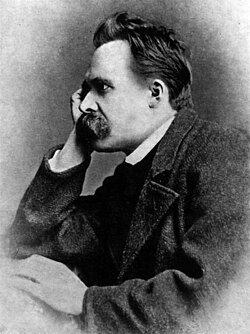
The Antichrist is a writing by Fredrich Nietzsche in which he directly attacks Christianity for being a supposedly weakness-encouraging and life-denying force. His arguments against Christianity are provocative and have challenged many people’s beliefs about it. His arguments revolve around the mistaken idea that Christianity is against strength, and therefore is counter to a fulfilling life as a human being. Examples from the bible show that Nietzsche was wrong in his assessment of Christianity and they turn Nietzsche’s arguments on their heads.
In The Antichrist, Nietzsche argues that “Christianity has taken the side of everything weak, base, ill-constituted, it has made an ideal out of opposition to the preservative instincts of strong life.” Essentially, Nietzsche thought that Christianity is a religion of weakness. This is far from the truth. However, it’s easy to understand how he got this impression. Christianity promotes gentleness, and peace, which can make it easy to suppose that Christianity is a religion of fearful weaklings. People who believe this miss the important concept that true gentleness and peace is not fearing or being unable to to act violently or be in conflict. Rather, true gentleness and true peace result from having the capability to act violently or be in conflict, but choosing not to. It is not righteousness to be peaceful and gentle as a result of fear or inability to be in conflict. If we were unable to sin and then didn’t sin, how is that praiseworthy? This is not to say that all conflict is sinful, but the point remains that true righteous gentleness and peacefulness stem from the ability to be in conflict, but choosing not to. In Ephesians it says “be angry and do not sin.” This implies the controlling of one’s potentially violent or sinful anger, and sums up how Christians can be strong while having qualities like gentleness and peacefulness.
Again in the Antichrist, Nietzsche argues that “Christianity is the negation of the will to life.” In a way Nietzsche is right that Christianity seeks to remove a certain fundamental aspect of our humanity, but this is a good thing, and the aspect that Christianity seeks to remove from us is not the “will to life.” Instead Christianity seeks to remove the will to sin. For those entrenched in sin, it could appear as if Christianity seeks to remove from one the “will to life,” instead of the will to sin. Not only does Christianity seek to remove the will to sin, it actively replaces this with the will to do right. In Ephesians, it says to put off the old man and put on the new man, representing the replacement of the will to sin with the will to do right. Nietzsche is right in a way that Christianity seeks to negate a fundamental aspect of our humanity – sin – but he mistakenly believes this to be that “will to life” rather than the will to sin.
In The Antichrist, Nietzsche discusses Christianity’s focus on helping the weak, asserting that it is “more harmful than any vice.” His argument is based on the idea that helping the weak celebrates weakness and suppresses strength. Jesus’s example in his healings show that Christianity’s focus on helping the weak doesn’t celebrate weakness or suppress strength. When helping the woman accused of adultery, he doesn’t passively prevent her from being stoned – a situation where she was weak – without dealing with the root cause of the situation. He tells her to “sin no more,” demonstrating how he deals with potentially the root cause of how she got herself into her situation of weakness in the first place. Jesus did not passively help individuals or accept their weakness. He instead exhorted them to deal with their weaknesses. The ultimate weakness is a propensity to sin, and in encouraging people not to sin, Christianity is the most anti-weakness religion there is.




Leave a Reply