
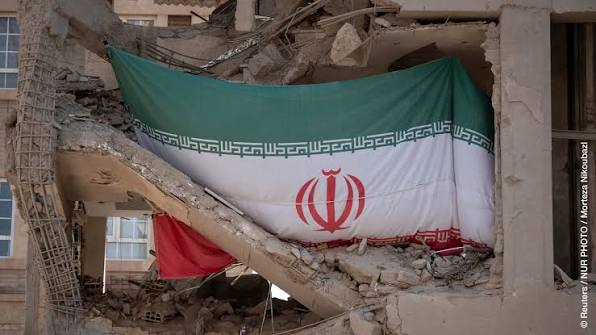
Recently, the United States and Iran signed a so-called Memorandum of Understanding, which temporarily ended the hostilities between the two countries. Many see this agreement as a moral loss for the United States and view it as a failure to accomplish the goals that America had going into the Iran war. Figures on both the right and left argue that these goals, primarily long-term denuclearization of Iran and regime change, have not been accomplished, and that America has wasted time and money on a war that achieved nothing. However, I believe that this marks a possible shift in Iran’s foreign policy calculus that may influence the future of the region for decades to come, and will prove a strategic win for the United States, and its allies.
It is true that the U.S. has not accomplished its initial goal of regime change, a goal hinted at by Trump when he assured Iranian dissidents that “help was on the way.” In my view though, the U.S. has learned from the war that regime change was not a feasible goal to begin with, as shown by point two of the MOU, which states that neither side will interfere in the other’s internal affairs.
The goal of preventing Iran from developing nuclear weapons, however, has not been a failure in the same way that the regime-change goal is. I believe that the U.S., whether intentionally or unintentionally, has taught Iran that it does not actually need a nuclear weapon to accomplish its strategic objectives. As a result, I believe that, at least in the short run, Iran may cease its development of nuclear weapons as a direct consequence of the recent war.
To analyze this, its important to understand why Iran wanted a nuclear weapon in the first place. One reason is that Iran views Western influence as subversive to its radical Islamic regime, and sees a powerful nuclear program as protection against that influence. The Iranian government may look to North Korea, a regime that one could argue is even more oppressive and tyrannical than Iran, and conclude that its autonomy and freedom from Western intervention are largely a result of its nuclear arsenal. The United States and other countries must treat North Korea carefully and avoid direct conflict, and Iran likely believes that if it develops nuclear weapons, it could enjoy a similar level of sovereignty.
Iran also understands that Israel, the region’s only nuclear power, is strongly opposed to Iran both politically and culturally. Iranian leaders believe that Israel desires regime change in Iran and wants to see the Islamic Republic fall in order to secure Israeli regional dominance in the Middle East. A functioning nuclear deterrent would make such efforts significantly more difficult.
In short, nuclear weapons would provide a bulwark against countries that seek to undermine Iranian sovereignty and would deter military action by states such as the United States and Israel. Another reason Iran might want a nuclear weapon is offensive rather than defensive. Some argue that Iran’s revolutionary ideology could ultimately lead it to use nuclear weapons against Israel or even the United States. Such an action would throw the world into chaos and could trigger a broader nuclear conflict.
So what has Iran learned from the war?
First, Iran has learned that the United States is unwilling to put boots on the ground. Iranian leaders realize that a full-scale invasion would be deeply unpopular domestically, and that the Trump administration is only willing to go as far as air strikes and blockading the Strait of Hormuz. Iran learned that it does not necessarily need nuclear weapons to survive this type of conflict. It need only maintain the capability to retaliate against Western military assets in the region.
Second, Iran has learned that Trump is willing to bomb Iranian targets and reinstate economic pressure if Iran continues pursuing policies viewed as threatening. These measures have inflicted severe economic damage on Iran and placed additional strain on an already fragile economy. Trump seems willing to do this at any whim, even leading up to a tightly contested midterms. Iran has no reason to believe that Trump will stop being willing to carry out airstrikes on Iran.
Third, Iran has learned that the goals of the United States and Israel are not entirely aligned in their objectives towards the war. A growing rift between Netanyahu and Trump has shown that Trump, at least at this stage, appears primarily concerned with denuclearization. He no longer seems as committed to regime change as he appeared to be at the beginning of the conflict. Netanyahu, by contrast, remains focused on weakening Iran’s regional position and, potentially, encouraging regime change.
Given these three lessons, why might Iran choose not to develop nuclear weapons going forward?
Iran has learned that it can preserve its sovereignty in a conflict with the United States so long as the conflict remains limited to air strikes and economic pressure. It no longer sees an American ground invasion as a likely outcome.
Iran also may conclude that it will achieve greater economic success by abandoning its pursuit of nuclear weapons. The regime faces significant domestic dissatisfaction, particularly among younger and more educated Iranians, as evidenced by the recent deadly protests. Iranian leaders already understand that a substantial segment of the population opposes the regime, and they may not wish to worsen existing tensions. If ending the nuclear program results in sanctions relief, reconstruction assistance, and renewed economic growth, the regime would have strong incentives to pursue that path. They also understand that continued pursuit of nuclear weapons could lead to renewed bombing campaigns and further economic isolation. Given Iran’s precarious economic situation, avoiding those outcomes may be a priority.
Finally, Iran may recognize that the growing divergence between the United States and Israel presents an opportunity. If the United States is primarily concerned with denuclearization while Israel continues to prioritize broader political goals, Iran may conclude that ending its nuclear program is the only major concession necessary to reach an agreement with Washington. In doing so, Iran could resolve the conflict largely on American terms rather than on terms that might threaten the survival of the regime itself.
As discussed earlier, Iran’s primary motivations for obtaining nuclear weapons were deterrence and, potentially, offensive use against its enemies. We have already examined why Iran may no longer view nuclear weapons as necessary for preserving sovereignty. We have also explored the economic and political incentives encouraging Iran to halt development. However, the question of offensive intent remains.
I believe that Iran’s commitment to the most hardline elements of its revolutionary ideology may be weakening. Evidence for this can be seen in the approval of the MOU. The Ayatollah reportedly stated that he was “in principle opposed” to the agreement, but ultimately accepted it on the advice of President Masoud Pezeshkian. This may suggest that preserving national stability and sovereignty is taking precedence over strict ideological commitments. If that is the case, then one of the last remaining motivations for pursuing nuclear weapons may be disappearing.
If this interpretation is correct, then Iran may actually abandon its long-held desire to possess nuclear weapons, at least in the short term. Whether this outcome was foreseen at the beginning of the war, or whether it emerged unintentionally, remains open to debate. Furthermore, recent statements from both the Ayatollah and the more Western-oriented President Pezeshkian may suggest that the regime is becoming somewhat more pragmatic in its approach to foreign policy. However, this remains far from certain.
The reality remains that the terms of the MOU have been violated and that negotiations have broken down between the U.S. and Iran. Events elsewhere in the Middle East in places such as Lebanon, may continue to destabilize negotiations. There is also the possibility that desires on either side change. For example, America may abandon it’s current aversion to a ground invasion, however unlikely that may be given the current unpopularity of the war in America.
While the ultimate outcome of this war remains uncertain, there exists, in my view, a plausible scenario in which Iran chooses to abandon the pursuit of nuclear weapons. If that occurs, it would represent a significant victory for the United States and for those who argued that denuclearization, rather than regime change, should be the primary objective. History suggests that this agreement is unlikely to produce lasting peace in the Middle East. Nevertheless, it may lead to at least temporary denuclearization of Iran, which would be a small but meaningful step in that direction.



Leave a Reply