
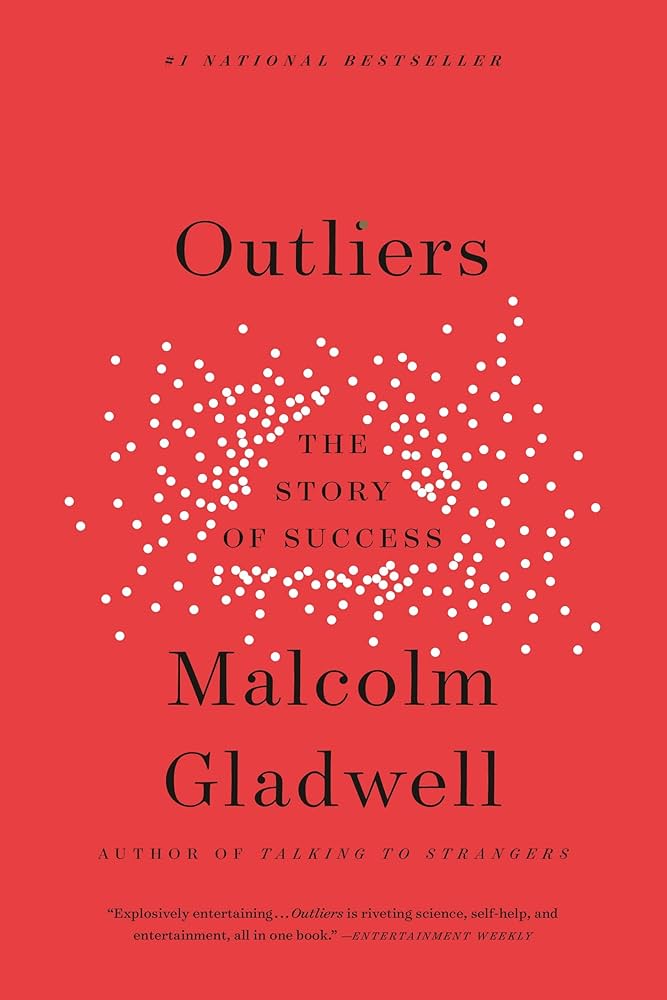
Gladwell’s basic premise in Outliers is that success that our aptitudes, opportunities, and proclivities are determined largely by our culture and the way we grow up, that success is never due to one’s solitary efforts, and is always because of some exceptional opportunities. He uses various examples of how culture and plain luck determine our future, our level of success, and our “natural” tendencies.
One example he uses is his comparison of the life of two very smart men, one successful and one conventionally unsuccessful. The first man is Robert Oppenheimer. Robert Oppenheimer was born to wealthy parents who pushed him in his education and hobbies. In one instance during a phase in which he was interested in Geology, he wrote a letter to a leading Geologist. The geologist, not realizing that he he was just 12 at the time, invited him to give a speech at a geology convention in the city. He was terrified to go, but his father pushed him to, eventually convincing him to do it. It was through prodding and cultivation by his parents that Oppenheimer learned how to deal with people in authority, influence others, and get what he wanted out of the world. The second man is Christopher Langan. Langan grew up without his father, and he and his siblings suffered physical abuse from their alcoholic stepfather for most of their lives. Langan was a genius – his IQ was tested to be around 200. He was able to simply skim through a textbook before a test in order to ace the test. He was able to master seemingly anything he wanted to in short order due to his immense intellect. However, he never ended up achieving the same level of conventional success that Oppenheimer did.
Gladwell then compares the two men’s college experiences. Langan was offered a full scholarship, but when his mother failed to sign his financial aid papers, he was sent home. Later, when he enrolled in the local state college, he dropped out when the college inexplicably refused a routine class change. Oppenheimer, on the other hand, attempted to poison his college professor because he was forced to take experimental physics instead of theoretical physics. He literally tried to murder his professor. His only consequence – to see the psychiatrist every two weeks. Langan was kicked out of college for failing to get a paper signed, and Oppenheimer was simply told to see a psychiatrist when he tried to murder his professor. Oppenheimer was able to influence and get his way with authority, where Langan, not being pushed to be this way by his parents, could not. This is why their experiences in college were so different. Later on Oppenheimer was able to lead the Manhattan project despite being younger than all the other scientists on the project, being a theoretical physicist instead of an experimental physicist, and having clear ties to the communist party. Why? Because he was able to influence and deal with authority.
This example illustrates his whole premise. Both men were born very naturally intelligent. It’s the difference in the family and the opportunity they were born into that made all the difference.
I think it’s time that the world stops believing the “self made” narrative. It’s never true. We should be less in awe of those who are successful, (“wow that guy’s so smart,” or “that person is so talented”) and instead have a more realistic view of success. We should acknowledge that while you must have some degree of natural talent to be successful, after that it’s all hard work, opportunity, and outside influence.


Leave a Reply